
Why you can’t compare office prices per square metre

At first glance, comparing office space seems easy.
One office is 10,000 SEK per month. Another is 15,000 SEK. One is 9000 SEK per square metre/year. Another is 12000 SEK/year.
So why would you pay more for the second one?
Because a square metre of empty office space and a square metre of fully serviced workspace are not the same product.
This is one of the most common mistakes we see when companies compare traditional office leases with coworking and serviced offices.
An empty office gives you the space.
A serviced office gives you the space plus everything that makes the space work as an office.
And when you rent an empty office, many of those costs don't disappear. They simply move into different invoices, suppliers, contracts, maintenance tasks and, sometimes, your own to-do list.
At Embassy House, we think the fairest way to compare offices is not to ask:
"What is the price per square metre?"
but:
"What does it actually cost us to operate this office?"
The empty-office price is rarely the real office price
Imagine you find a traditional office with a very attractive rent.
The landlord gives you four walls, floors, windows and perhaps heating.
Everything else is up to you.
You may need to arrange internet. WiFi. A firewall. Access control. Alarms. Security. Cleaning. Coffee. Furniture. Meeting rooms. Waste collection. Printers. Kitchen equipment. Maintenance.
You also need to think about what happens when something breaks.
Who calls the technician?
Who manages the access system when a new employee starts?
Who removes an old employee's access?
Who makes sure the office is clean?
Who buys coffee?
Who deals with the internet when it goes down?
Who books and pays for a meeting room when you need to bring ten people together?
Running an office is full of small, boring things that still need to happen.
And someone has to spend time making them happen.
What does a serviced office actually include?
Let's use a simple example.
The following are approximate costs for services that a company may need to arrange separately when operating its own office. Actual costs vary considerably depending on the building, size of the office, number of employees, specification and suppliers.
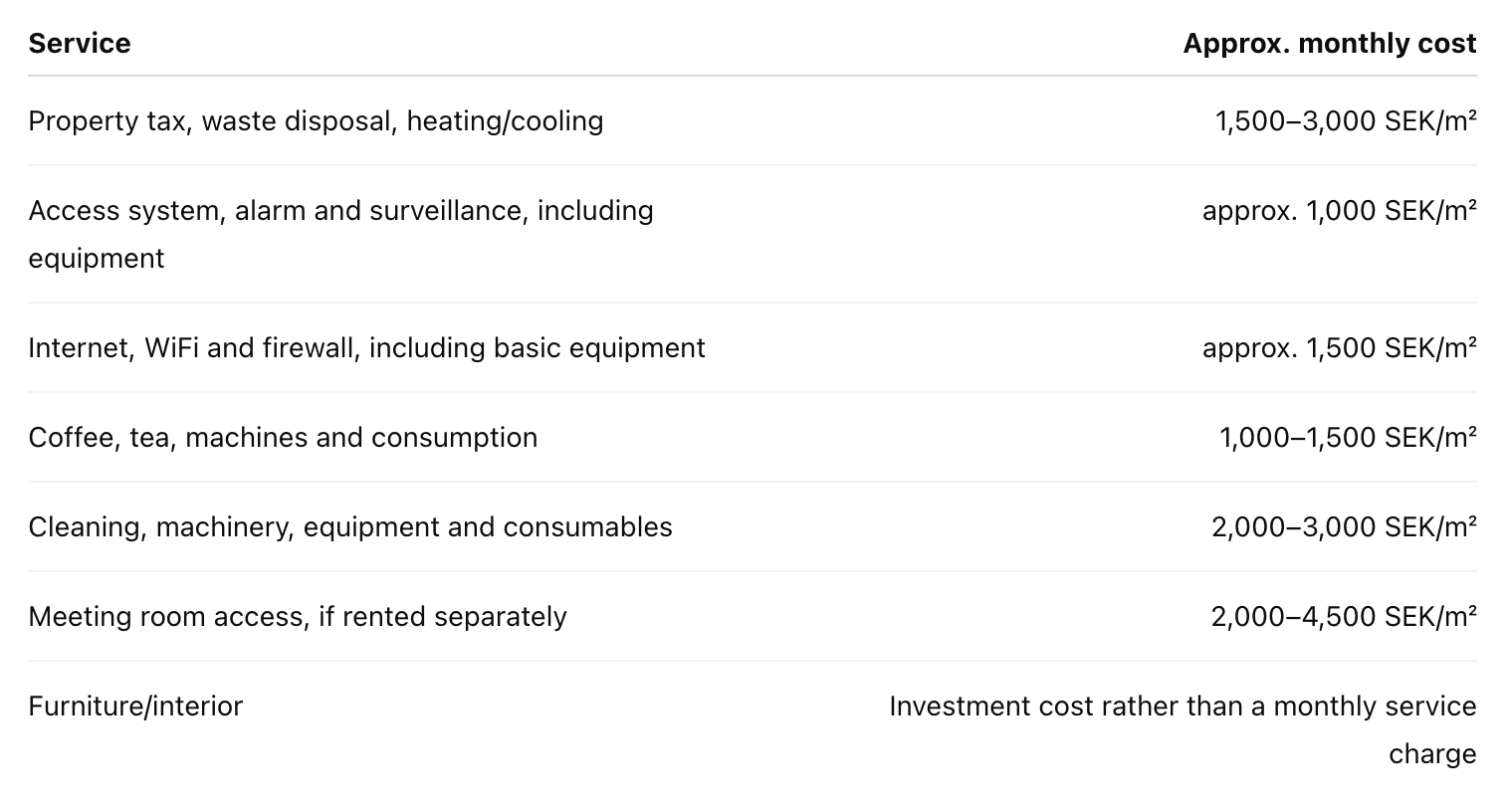
That means the services alone could represent roughly 9,000–14,500 SEK per m² per month in this illustrative calculation, before you even get to the actual office rent.
These figures are not intended to be a universal price list. They are a way of showing something that is easy to miss when comparing office offers:
the rent is only one part of the cost of having an office.
And there is another cost that doesn't appear neatly in a spreadsheet.
Your time.
The hidden cost: managing the office yourself
An office does not run itself.
Someone has to manage suppliers, access, maintenance, cleaning, security, internet, furniture, meeting rooms and everything else that comes with having your own premises.
For a small company, that person is often the founder.
Or the office manager.
Or whoever happens to notice that the coffee machine has stopped working.
That's not necessarily a problem. Some companies genuinely want to manage their own premises. They may need highly customised space, have facilities expertise internally, or simply prefer having complete control.
But it is worth putting a value on that choice.
If your team spends several hours every month dealing with office operations, that is still a cost. It just doesn't appear under "rent".
And if you are comparing a traditional office with a coworking space, you are not comparing two versions of the same thing.
You are comparing two different operating models.
What about the legal and compliance side?
This is another part of the comparison that can disappear when you look only at SEK per square metre.
Renting an empty office does not mean you can simply put some desks in it and forget about everything else.
Your company still has responsibilities as an employer and as the operator of its business.
Exactly who is responsible for what depends on the building, the lease agreement and the arrangements with the property owner. Not every legal obligation automatically transfers to the tenant.
But there are several areas that a company operating its own office needs to understand and manage.
1. Work environment
In Sweden, employers have a responsibility to systematically manage the work environment.
That includes identifying risks, assessing them, taking action and following up. The Swedish Work Environment Authority's rules on systematic work environment management apply to workplaces where employees work for an employer.
This is much broader than simply providing a desk.
The work environment can include things such as:
lighting
temperature
noise
ergonomics
workplace layout
safety
ventilation and air quality
physical and organisational working conditions
For companies with their own premises, someone needs to make sure these things are actually being managed.
2. Ventilation and indoor climate
The Swedish Work Environment Authority states that employers are responsible for reducing risks associated with poor ventilation and air quality as part of their work environment responsibilities. Indoor workplaces must have ventilation that contributes to a good indoor climate and provides sufficient outdoor air.
If something is wrong with the ventilation in your office, you therefore need a process for identifying the problem and getting it addressed.
Depending on the issue, the responsibility for the building's ventilation system may sit with the property owner rather than the tenant. But from an employer's perspective, the impact on your workplace still needs to be dealt with.
3. Fire safety
Fire safety is another area where having your own premises means understanding who does what.
A company needs appropriate routines for fire safety, evacuation and emergency procedures. The responsibilities between the property owner and the business using the premises need to be clear.
That can include things such as:
evacuation procedures
emergency information
fire safety routines
staff knowledge and training
keeping escape routes clear
annual checks of fire extinguishers
coordination with the building's fire protection arrangements
Systematic fire safety work is intended to ensure that both technical fire protection and the organisation around fire safety are maintained over time.
In a serviced office or coworking environment, much of the building-level infrastructure and coordination is already established. That doesn't remove your responsibility as an employer to make sure your own employees know what to do in an emergency, but it can mean there is considerably less infrastructure for your company to create and maintain from scratch.
4. Electrical safety
Electrical safety is another example of why the office rent isn't the whole picture.
Sweden's Electrical Safety Authority states that employers have an overall responsibility for electrical safety as part of the work environment, while the holder of an electrical installation also has specific responsibilities for ensuring that the installation and equipment are safe and are regularly checked.
Again, this is an area where the exact division of responsibility matters.
A commercial tenant shouldn't assume that it is responsible for everything in the building. But it also shouldn't assume that electrical safety simply isn't its problem.
Clear responsibilities and routines matter.
5. Access control, alarms and surveillance
A traditional office may require you to arrange your own access control, alarm system and potentially surveillance.
And surveillance comes with additional considerations.
If your company uses cameras that capture employees or visitors, you are potentially processing personal data and need to comply with GDPR and the Swedish Camera Surveillance Act. IMY states that employers need a legal basis for workplace camera surveillance and must consider issues including purpose, necessity, scope, storage and access to recordings.
In other words, installing a few cameras isn't simply a case of buying the equipment and putting them on the wall.
Access control is often a simpler alternative where the goal is to prevent unauthorised people from entering but simple wiring, installation of access readers and an access management tool can easily reach 65,000 - 75,000 SEK with ongoing monthly costs.
6. Waste and recycling
Someone also needs to deal with the physical output of an office.
General waste. Packaging. Paper. Food waste. Recycling.
Depending on the premises and lease, waste collection may be included in the property arrangement or may need to be organised separately by the tenant. Some landlords have a chosen waste management partner that you have to use. Some landlords let you choose your own provider, but you are often charged for the number of bins and the amount of waste, plus extra for additional collections or incorrect sorting.
The important point is that it needs to be accounted for somewhere.
7. Accessibility and the workplace itself
There are also requirements around how workplaces and buildings are designed and used.
Swedish building regulations include requirements relating to accessibility and usability, with specific rules and exceptions for workplaces depending on the nature of the activity. The Work Environment Authority also addresses accessibility, workplace layout and the physical working environment.
This becomes particularly relevant if you're fitting out, altering or rebuilding an empty office.
Once you start moving walls, installing equipment or changing how a space is used, you're no longer just choosing where to put the desks.
You are managing a workplace.
Then there is the cost of setting the office up in the first place
Let's say you have found the perfect empty office.
Now you need to make it an office.
Desks.
Chairs.
Lighting.
Storage.
Kitchen equipment.
Plants, if that's your thing.
Printers.
Screens.
Whiteboards.
Coffee machine.
Internet equipment.
Access control.
Recycling.
Maybe soundproofing.
Maybe a meeting room.
And suddenly the "cheap" office requires a fairly substantial upfront investment.
Furniture is different from the recurring costs above because it is normally an investment rather than a monthly service expense. It can be depreciated over time.
But the cash still has to leave your bank account.
At Embassy House, the furniture and interior are already there.
You don't need to buy an office before you can start using one.
Meeting rooms are a particularly easy cost to overlook
This one catches people out.
You might only need a private office for six people, so you compare the price of that room with the price of a six-person office elsewhere.
But where do you meet everyone else?
If you need a proper meeting room, workshop space, boardroom or presentation space, you may end up renting additional rooms elsewhere.
At Embassy House, access to approximately nine fully equipped meeting rooms is part of the workspace setup, with 10–20 hours of meeting room use included in the rent, depending on the membership.
If you had to rent equivalent meeting space separately, the illustrative cost can be significant.
Again, the point isn't that every company would spend exactly the same amount.
The point is that meeting space has a value.
If you need it, you should include it when comparing offices.
The liquidity question
There is another difference that doesn't show up in the square-metre calculation.
Deposits.
Traditional commercial leases can involve a security deposit or other form of security, depending on the agreement.
At Embassy House, we don't charge a deposit with our standard agreements.
That means you don't have to tie up cash simply to secure your office.
For a startup or growing company, that can matter more than another line in the monthly rent calculation.
Cash sitting in your business is cash you can use for hiring, product development, marketing, equipment or simply keeping the business moving.
Flexibility has a value too
Then there is the question nobody likes to put into the spreadsheet:
What happens if your team changes?
You might start with eight people and end up with five.
Or eight becomes twelve.
Or the company raises money and grows quickly.
Or the whole team goes hybrid.
Or you realise six months later that the office you thought you needed isn't actually the right setup.
Traditional office leases can work very well for companies that know exactly what they need and are happy to commit for a longer period.
But flexibility has value.
At Embassy House, our private offices have a three-month notice period.
That gives companies room to change without being locked into a workspace for years.
You are paying for workspace, not making a long-term bet on what your company will look like three years from now.
So what should you actually compare?
When you're looking at office options, we'd suggest putting the spreadsheet back on the table.
Just make it a little bigger.
Instead of:
Rent per m²
compare:
Total cost of running the workplace.
That means looking at:
Rent
Heating and cooling
Property-related costs
Waste
Internet
WiFi
Firewall
Access control
Alarm and security
Cleaning
Coffee and kitchen facilities
Furniture
Maintenance
Meeting rooms
Fit-out and setup costs
Deposits and tied-up cash
Internal time spent managing the office
Flexibility and notice period
Then ask a slightly different question:
How much does it cost us to have a functioning office where our team can actually work?
That's a much more useful number.
Coworking isn't necessarily more expensive. It's a different way of buying an office.
The biggest misunderstanding about coworking is that you're paying a premium for a desk.
You're not.
You are paying for an operating model.
Instead of buying an empty space and building an office operation around it, you are buying access to an office that is already operating.
The internet is there.
The coffee is there.
The furniture is there.
The meeting rooms are there.
The cleaning is organised.
The access system works.
The building is being managed.
And when something goes wrong, there is someone whose job it is to deal with it.
Most of the costs are shared between multiple companies which means your individual cost is far less.
That's the part of coworking that doesn't show up when you compare SEK per square metre.
At Embassy House, that's the whole point.
We provide private offices for teams, but we don't think of them as empty rooms with desks.
We think of them as ready-to-use workplaces.
You bring your people.
You bring your laptops.
You get to work.
The rest is what we're here for.
And if you want to compare us with a traditional office, absolutely do it.
Just compare the whole cost of the office, not only the cost of the four walls.